Number theory
Number theory (or arithmetic or higher arithmetic in older usage) is a branch of pure mathematics devoted primarily to the study of the integers and arithmetic functions. German mathematician Carl Friedrich Gauss (1777–1855) said, "Mathematics is the queen of the sciences—and number theory is the queen of mathematics."[1][note 1] Number theorists study prime numbers as well as the properties of mathematical objects constructed from integers (for example, rational numbers), or defined as generalizations of the integers (for example, algebraic integers).
Integers can be considered either in themselves or as solutions to equations (Diophantine geometry). Questions in number theory are often best understood through the study of analytical objects (for example, the Riemann zeta function) that encode properties of the integers, primes or other number-theoretic objects in some fashion (analytic number theory). One may also study real numbers in relation to rational numbers, for example, as approximated by the latter (Diophantine approximation).
The older term for number theory is arithmetic. By the early twentieth century, it had been superseded by "number theory".[note 2] (The word "arithmetic" is used by the general public to mean "elementary calculations"; it has also acquired other meanings in mathematical logic, as in Peano arithmetic, and computer science, as in floating-point arithmetic.) The use of the term arithmetic for number theory regained some ground in the second half of the 20th century, arguably in part due to French influence.[note 3] In particular, arithmetical is commonly preferred as an adjective to number-theoretic.
History[edit]
Origins[edit]
Dawn of arithmetic[edit]

The earliest historical find of an arithmetical nature is a fragment of a table: the broken clay tablet Plimpton 322 (Larsa, Mesopotamia, ca. 1800 BC) contains a list of "Pythagorean triples", that is, integers such that . The triples are too many and too large to have been obtained by brute force. The heading over the first column reads: "The takiltum of the diagonal which has been subtracted such that the width..."[2]


The table's layout suggests[3] that it was constructed by means of what amounts, in modern language, to the identity

which is implicit in routine Old Babylonian exercises.[4] If some other method was used,[5] the triples were first constructed and then reordered by , presumably for actual use as a "table", for example, with a view to applications.

It is not known what these applications may have been, or whether there could have been any; Babylonian astronomy, for example, truly came into its own only later. It has been suggested instead that the table was a source of numerical examples for school problems.[6][note 4]
While Babylonian number theory—or what survives of Babylonian mathematics that can be called thus—consists of this single, striking fragment, Babylonian algebra (in the secondary-school sense of "algebra") was exceptionally well developed.[7] Late Neoplatonic sources[8] state that Pythagoras learned mathematics from the Babylonians. Much earlier sources[9] state that Thales and Pythagoras traveled and studied in Egypt.
Euclid IX 21–34 is very probably Pythagorean;[10] it is very simple material ("odd times even is even", "if an odd number measures [= divides] an even number, then it also measures [= divides] half of it"), but it is all that is needed to prove that is irrational.[11] Pythagorean mystics gave great importance to the odd and the even.[12] The discovery that is irrational is credited to the early Pythagoreans (pre-Theodorus).[13] By revealing (in modern terms) that numbers could be irrational, this discovery seems to have provoked the first foundational crisis in mathematical history; its proof or its divulgation are sometimes credited to Hippasus, who was expelled or split from the Pythagorean sect.[14] This forced a distinction between numbers (integers and the rationals—the subjects of arithmetic), on the one hand, and lengths and proportions (which we would identify with real numbers, whether rational or not), on the other hand.

The Pythagorean tradition spoke also of so-called polygonal or figurate numbers.[15] While square numbers, cubic numbers, etc., are seen now as more natural than triangular numbers, pentagonal numbers, etc., the study of the sums of triangular and pentagonal numbers would prove fruitful in the early modern period (17th to early 19th century).
We know of no clearly arithmetical material in ancient Egyptian or Vedic sources, though there is some algebra in each. The Chinese remainder theorem appears as an exercise [16] in Sunzi Suanjing (3rd, 4th or 5th century CE).[17] (There is one important step glossed over in Sunzi's solution:[note 5] it is the problem that was later solved by Āryabhaṭa's Kuṭṭaka – see below.)
There is also some numerical mysticism in Chinese mathematics,[note 6] but, unlike that of the Pythagoreans, it seems to have led nowhere. Like the Pythagoreans' perfect numbers, magic squares have passed from superstition into recreation.
Classical Greece and the early Hellenistic period[edit]
Aside from a few fragments, the mathematics of Classical Greece is known to us either through the reports of contemporary non-mathematicians or through mathematical works from the early Hellenistic period.[18] In the case of number theory, this means, by and large, Plato and Euclid, respectively.
While Asian mathematics influenced Greek and Hellenistic learning, it seems to be the case that Greek mathematics is also an indigenous tradition.
Eusebius, PE X, chapter 4 mentions of Pythagoras:
Aristotle claimed that the philosophy of Plato closely followed the teachings of the Pythagoreans,[20] and Cicero repeats this claim: Platonem ferunt didicisse Pythagorea omnia ("They say Plato learned all things Pythagorean").[21]
Plato had a keen interest in mathematics, and distinguished clearly between arithmetic and calculation. (By arithmetic he meant, in part, theorising on number, rather than what arithmetic or number theory have come to mean.) It is through one of Plato's dialogues—namely, Theaetetus—that we know that Theodorus had proven that are irrational. Theaetetus was, like Plato, a disciple of Theodorus's; he worked on distinguishing different kinds of incommensurables, and was thus arguably a pioneer in the study of number systems. (Book X of Euclid's Elements is described by Pappus as being largely based on Theaetetus's work.)

Euclid devoted part of his Elements to prime numbers and divisibility, topics that belong unambiguously to number theory and are basic to it (Books VII to IX of Euclid's Elements). In particular, he gave an algorithm for computing the greatest common divisor of two numbers (the Euclidean algorithm; Elements, Prop. VII.2) and the first known proof of the infinitude of primes (Elements, Prop. IX.20).
In 1773, Lessing published an epigram he had found in a manuscript during his work as a librarian; it claimed to be a letter sent by Archimedes to Eratosthenes.[22][23] The epigram proposed what has become known as Archimedes's cattle problem; its solution (absent from the manuscript) requires solving an indeterminate quadratic equation (which reduces to what would later be misnamed Pell's equation). As far as we know, such equations were first successfully treated by the Indian school. It is not known whether Archimedes himself had a method of solution.
Diophantus[edit]

Very little is known about Diophantus of Alexandria; he probably lived in the third century AD, that is, about five hundred years after Euclid. Six out of the thirteen books of Diophantus's Arithmetica survive in the original Greek and four more survive in an Arabic translation. The Arithmetica is a collection of worked-out problems where the task is invariably to find rational solutions to a system of polynomial equations, usually of the form or . Thus, nowadays, we speak of Diophantine equations when we speak of polynomial equations to which rational or integer solutions must be found.

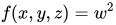
One may say that Diophantus was studying rational points, that is, points whose coordinates are rational—on curves and algebraic varieties; however, unlike the Greeks of the Classical period, who did what we would now call basic algebra in geometrical terms, Diophantus did what we would now call basic algebraic geometry in purely algebraic terms. In modern language, what Diophantus did was to find rational parametrizations of varieties; that is, given an equation of the form (say) , his aim was to find (in essence) three rational functions such that, for all values of and , setting for gives a solution to




Diophantus also studied the equations of some non-rational curves, for which no rational parametrisation is possible. He managed to find some rational points on these curves (elliptic curves, as it happens, in what seems to be their first known occurrence) by means of what amounts to a tangent construction: translated into coordinate geometry (which did not exist in Diophantus's time), his method would be visualised as drawing a tangent to a curve at a known rational point, and then finding the other point of intersection of the tangent with the curve; that other point is a new rational point. (Diophantus also resorted to what could be called a special case of a secant construction.)
While Diophantus was concerned largely with rational solutions, he assumed some results on integer numbers, in particular that every integer is the sum of four squares (though he never stated as much explicitly).
Āryabhaṭa, Brahmagupta, Bhāskara[edit]
While Greek astronomy probably influenced Indian learning, to the point of introducing trigonometry,[24] it seems to be the case that Indian mathematics is otherwise an indigenous tradition;[25] in particular, there is no evidence that Euclid's Elements reached India before the 18th century.[26]
Āryabhaṭa (476–550 AD) showed that pairs of simultaneous congruences , could be solved by a method he called kuṭṭaka, or pulveriser;[27] this is a procedure close to (a generalisation of) the Euclidean algorithm, which was probably discovered independently in India.[28] Āryabhaṭa seems to have had in mind applications to astronomical calculations.[24]


Brahmagupta (628 AD) started the systematic study of indefinite quadratic equations—in particular, the misnamed Pell equation, in which Archimedes may have first been interested, and which did not start to be solved in the West until the time of Fermat and Euler. Later Sanskrit authors would follow, using Brahmagupta's technical terminology. A general procedure (the chakravala, or "cyclic method") for solving Pell's equation was finally found by Jayadeva (cited in the eleventh century; his work is otherwise lost); the earliest surviving exposition appears in Bhāskara II's Bīja-gaṇita (twelfth century).[29]
Indian mathematics remained largely unknown in Europe until the late eighteenth century;[30] Brahmagupta and Bhāskara's work was translated into English in 1817 by Henry Colebrooke.[31]
Arithmetic in the Islamic golden age[edit]
Integers can be considered either in themselves or as solutions to equations (Diophantine geometry). Questions in number theory are often best understood through the study of analytical objects (for example, the Riemann zeta function) that encode properties of the integers, primes or other number-theoretic objects in some fashion (analytic number theory). One may also study real numbers in relation to rational numbers, for example, as approximated by the latter (Diophantine approximation).
The older term for number theory is arithmetic. By the early twentieth century, it had been superseded by "number theory".[note 2] (The word "arithmetic" is used by the general public to mean "elementary calculations"; it has also acquired other meanings in mathematical logic, as in Peano arithmetic, and computer science, as in floating-point arithmetic.) The use of the term arithmetic for number theory regained some ground in the second half of the 20th century, arguably in part due to French influence.[note 3] In particular, arithmetical is commonly preferred as an adjective to number-theoretic.
History[edit]
Origins[edit]
Dawn of arithmetic[edit]
The earliest historical find of an arithmetical nature is a fragment of a table: the broken clay tablet Plimpton 322 (Larsa, Mesopotamia, ca. 1800 BC) contains a list of "Pythagorean triples", that is, integers such that . The triples are too many and too large to have been obtained by brute force. The heading over the first column reads: "The takiltum of the diagonal which has been subtracted such that the width..."[2]
The table's layout suggests[3] that it was constructed by means of what amounts, in modern language, to the identity
which is implicit in routine Old Babylonian exercises.[4] If some other method was used,[5] the triples were first constructed and then reordered by , presumably for actual use as a "table", for example, with a view to applications.
It is not known what these applications may have been, or whether there could have been any; Babylonian astronomy, for example, truly came into its own only later. It has been suggested instead that the table was a source of numerical examples for school problems.[6][note 4]
While Babylonian number theory—or what survives of Babylonian mathematics that can be called thus—consists of this single, striking fragment, Babylonian algebra (in the secondary-school sense of "algebra") was exceptionally well developed.[7] Late Neoplatonic sources[8] state that Pythagoras learned mathematics from the Babylonians. Much earlier sources[9] state that Thales and Pythagoras traveled and studied in Egypt.
Euclid IX 21–34 is very probably Pythagorean;[10] it is very simple material ("odd times even is even", "if an odd number measures [= divides] an even number, then it also measures [= divides] half of it"), but it is all that is needed to prove that is irrational.[11] Pythagorean mystics gave great importance to the odd and the even.[12] The discovery that is irrational is credited to the early Pythagoreans (pre-Theodorus).[13] By revealing (in modern terms) that numbers could be irrational, this discovery seems to have provoked the first foundational crisis in mathematical history; its proof or its divulgation are sometimes credited to Hippasus, who was expelled or split from the Pythagorean sect.[14] This forced a distinction between numbers (integers and the rationals—the subjects of arithmetic), on the one hand, and lengths and proportions (which we would identify with real numbers, whether rational or not), on the other hand.
The Pythagorean tradition spoke also of so-called polygonal or figurate numbers.[15] While square numbers, cubic numbers, etc., are seen now as more natural than triangular numbers, pentagonal numbers, etc., the study of the sums of triangular and pentagonal numbers would prove fruitful in the early modern period (17th to early 19th century).
We know of no clearly arithmetical material in ancient Egyptian or Vedic sources, though there is some algebra in each. The Chinese remainder theorem appears as an exercise [16] in Sunzi Suanjing (3rd, 4th or 5th century CE).[17] (There is one important step glossed over in Sunzi's solution:[note 5] it is the problem that was later solved by Āryabhaṭa's Kuṭṭaka – see below.)
There is also some numerical mysticism in Chinese mathematics,[note 6] but, unlike that of the Pythagoreans, it seems to have led nowhere. Like the Pythagoreans' perfect numbers, magic squares have passed from superstition into recreation.
Classical Greece and the early Hellenistic period[edit]
Aside from a few fragments, the mathematics of Classical Greece is known to us either through the reports of contemporary non-mathematicians or through mathematical works from the early Hellenistic period.[18] In the case of number theory, this means, by and large, Plato and Euclid, respectively.
While Asian mathematics influenced Greek and Hellenistic learning, it seems to be the case that Greek mathematics is also an indigenous tradition.
Eusebius, PE X, chapter 4 mentions of Pythagoras:
Aristotle claimed that the philosophy of Plato closely followed the teachings of the Pythagoreans,[20] and Cicero repeats this claim: Platonem ferunt didicisse Pythagorea omnia ("They say Plato learned all things Pythagorean").[21]
Plato had a keen interest in mathematics, and distinguished clearly between arithmetic and calculation. (By arithmetic he meant, in part, theorising on number, rather than what arithmetic or number theory have come to mean.) It is through one of Plato's dialogues—namely, Theaetetus—that we know that Theodorus had proven that are irrational. Theaetetus was, like Plato, a disciple of Theodorus's; he worked on distinguishing different kinds of incommensurables, and was thus arguably a pioneer in the study of number systems. (Book X of Euclid's Elements is described by Pappus as being largely based on Theaetetus's work.)
Euclid devoted part of his Elements to prime numbers and divisibility, topics that belong unambiguously to number theory and are basic to it (Books VII to IX of Euclid's Elements). In particular, he gave an algorithm for computing the greatest common divisor of two numbers (the Euclidean algorithm; Elements, Prop. VII.2) and the first known proof of the infinitude of primes (Elements, Prop. IX.20).
In 1773, Lessing published an epigram he had found in a manuscript during his work as a librarian; it claimed to be a letter sent by Archimedes to Eratosthenes.[22][23] The epigram proposed what has become known as Archimedes's cattle problem; its solution (absent from the manuscript) requires solving an indeterminate quadratic equation (which reduces to what would later be misnamed Pell's equation). As far as we know, such equations were first successfully treated by the Indian school. It is not known whether Archimedes himself had a method of solution.
Diophantus[edit]
Very little is known about Diophantus of Alexandria; he probably lived in the third century AD, that is, about five hundred years after Euclid. Six out of the thirteen books of Diophantus's Arithmetica survive in the original Greek and four more survive in an Arabic translation. The Arithmetica is a collection of worked-out problems where the task is invariably to find rational solutions to a system of polynomial equations, usually of the form or . Thus, nowadays, we speak of Diophantine equations when we speak of polynomial equations to which rational or integer solutions must be found.
One may say that Diophantus was studying rational points, that is, points whose coordinates are rational—on curves and algebraic varieties; however, unlike the Greeks of the Classical period, who did what we would now call basic algebra in geometrical terms, Diophantus did what we would now call basic algebraic geometry in purely algebraic terms. In modern language, what Diophantus did was to find rational parametrizations of varieties; that is, given an equation of the form (say) , his aim was to find (in essence) three rational functions such that, for all values of and , setting for gives a solution to
Diophantus also studied the equations of some non-rational curves, for which no rational parametrisation is possible. He managed to find some rational points on these curves (elliptic curves, as it happens, in what seems to be their first known occurrence) by means of what amounts to a tangent construction: translated into coordinate geometry (which did not exist in Diophantus's time), his method would be visualised as drawing a tangent to a curve at a known rational point, and then finding the other point of intersection of the tangent with the curve; that other point is a new rational point. (Diophantus also resorted to what could be called a special case of a secant construction.)
While Diophantus was concerned largely with rational solutions, he assumed some results on integer numbers, in particular that every integer is the sum of four squares (though he never stated as much explicitly).
Āryabhaṭa, Brahmagupta, Bhāskara[edit]
While Greek astronomy probably influenced Indian learning, to the point of introducing trigonometry,[24] it seems to be the case that Indian mathematics is otherwise an indigenous tradition;[25] in particular, there is no evidence that Euclid's Elements reached India before the 18th century.[26]
Āryabhaṭa (476–550 AD) showed that pairs of simultaneous congruences , could be solved by a method he called kuṭṭaka, or pulveriser;[27] this is a procedure close to (a generalisation of) the Euclidean algorithm, which was probably discovered independently in India.[28] Āryabhaṭa seems to have had in mind applications to astronomical calculations.[24]
Brahmagupta (628 AD) started the systematic study of indefinite quadratic equations—in particular, the misnamed Pell equation, in which Archimedes may have first been interested, and which did not start to be solved in the West until the time of Fermat and Euler. Later Sanskrit authors would follow, using Brahmagupta's technical terminology. A general procedure (the chakravala, or "cyclic method") for solving Pell's equation was finally found by Jayadeva (cited in the eleventh century; his work is otherwise lost); the earliest surviving exposition appears in Bhāskara II's Bīja-gaṇita (twelfth century).[29]
Indian mathematics remained largely unknown in Europe until the late eighteenth century;[30] Brahmagupta and Bhāskara's work was translated into English in 1817 by Henry Colebrooke.[31]
Arithmetic in the Islamic golden age[edit]

In the early ninth century, the caliph Al-Ma'mun ordered translations of many Greek mathematical works and at least one Sanskrit work (the Sindhind, which may [32] or may not[33] be Brahmagupta's Brāhmasphuṭasiddhānta). Diophantus's main work, the Arithmetica, was translated into Arabic by Qusta ibn Luqa (820–912). Part of the treatise al-Fakhri (by al-Karajī, 953 – ca. 1029) builds on it to some extent. According to Rashed Roshdi, Al-Karajī's contemporary Ibn al-Haytham knew[34] what would later be called Wilson's theorem.
Western Europe in the Middle Ages[edit]
Other than a treatise on squares in arithmetic progression by Fibonacci—who traveled and studied in north Africa and Constantinople—no number theory to speak of was done in western Europe during the Middle Ages. Matters started to change in Europe in the late Renaissance, thanks to a renewed study of the works of Greek antiquity. A catalyst was the textual emendation and translation into Latin of Diophantus' Arithmetica.[35]
In the early ninth century, the caliph Al-Ma'mun ordered translations of many Greek mathematical works and at least one Sanskrit work (the Sindhind, which may [32] or may not[33] be Brahmagupta's Brāhmasphuṭasiddhānta). Diophantus's main work, the Arithmetica, was translated into Arabic by Qusta ibn Luqa (820–912). Part of the treatise al-Fakhri (by al-Karajī, 953 – ca. 1029) builds on it to some extent. According to Rashed Roshdi, Al-Karajī's contemporary Ibn al-Haytham knew[34] what would later be called Wilson's theorem.
Western Europe in the Middle Ages[edit]
Other than a treatise on squares in arithmetic progression by Fibonacci—who traveled and studied in north Africa and Constantinople—no number theory to speak of was done in western Europe during the Middle Ages. Matters started to change in Europe in the late Renaissance, thanks to a renewed study of the works of Greek antiquity. A catalyst was the textual emendation and translation into Latin of Diophantus' Arithmetica.[35]


Comments
Post a Comment