Compactness
Compactness[edit]
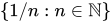
Compactness is a concept from general topology that plays an important role in many of the theorems of real analysis. The property of compactness is a generalization of the notion of a set being closed and bounded. (In the context of real analysis, these notions are equivalent: a set in Euclidean space is compact if and only if it is closed and bounded.) Briefly, a closed set contains all of its boundary points, while a set is bounded if there exists a real number such that the distance between any two points of the set is less than that number. In , sets that are closed and bounded, and therefore compact, include the empty set, any finite number of points, closed intervals, and their finite unions. However, this list is not exhaustive; for instance, the set is a compact set; the Cantor ternary set is another example of a compact set. On the other hand, the set is not compact because it is bounded but not closed, as the boundary point 0 is not a member of the set. The set is also not compact because it is closed but not bounded.


![{\displaystyle {\mathcal {C}}\subset [0,1]}](https://wikimedia.org/api/rest_v1/media/math/render/svg/8aaa630e6658df0560ae1e76d3ffa0830927d124)

For subsets of the real numbers, there are several equivalent definitions of compactness.
Definition. A set is compact if it is closed and bounded.

This definition also holds for Euclidean space of any finite dimension, , but it is not valid for metric spaces in general. The equivalence of the definition with the definition of compactness based on subcovers, given later in this section, is known as the Heine-Borel theorem.

A more general definition that applies to all metric spaces uses the notion of a subsequence (see above).
Definition. A set in a metric space is compact if every sequence in has a convergent subsequence.

This particular property is known as subsequential compactness. In , a set is subsequentially compact if and only if it is closed and bounded, making this definition equivalent to the one given above. Subsequential compactness is equivalent to the definition of compactness based on subcovers for metric spaces, but not for topological spaces in general.
The most general definition of compactness relies on the notion of open covers and subcovers, which is applicable to topological spaces (and thus to metric spaces and as special cases). In brief, a collection of open sets is said to be an open cover of set if the union of these sets is a superset of . This open cover is said to have a finite subcover if a finite subcollection of the could be found that also covers .


Definition. A set in a topological space is compact if every open cover of has a finite subcover.
Compact sets are well-behaved with respect to properties like convergence and continuity. For instance, any Cauchy sequence in a compact metric space is convergent. As another example, the image of a compact metric space under a continuous map is also compact.
Continuity[edit]
A function from the set of real numbers to the real numbers can be represented by a graph in the Cartesian plane; such a function is continuous if, roughly speaking, the graph is a single unbroken curve with no "holes" or "jumps".
There are several ways to make this intuition mathematically rigorous. Several definitions of varying levels of generality can be given. In cases where two or more definitions are applicable, they are readily shown to be equivalent to one another, so the most convenient definition can be used to determine whether a given function is continuous or not. In the first definition given below, is a function defined on a non-degenerate interval of the set of real numbers as its domain. Some possibilities include , the whole set of real numbers, an open interval or a closed interval Here, and are distinct real numbers, and we exclude the case of being empty or consisting of only one point, in particular.



![{\displaystyle I=[a,b]=\{x\in \mathbb {R} \mid a\leq x\leq b\}.}](https://wikimedia.org/api/rest_v1/media/math/render/svg/64cc8f1f9b93def98c6a4f0ec33ecd243a52ad8f)


Definition. If is a non-degenerate interval, we say that is continuous at if . We say that is a continuous map if is continuous at every .




In contrast to the requirements for to have a limit at a point , which do not constrain the behavior of at itself, the following two conditions, in addition to the existence of , must also hold in order for to be continuous at : (i) must be defined at , i.e., is in the domain of ; and (ii) as . The definition above actually applies to any domain that does not contain an isolated point, or equivalently, where every is a limit point of . A more general definition applying to with a general domain is the following:


Definition. If is an arbitrary subset of , we say that is continuous at if, for any , there exists such that for all , implies that . We say that is a continuous map if is continuous at every .



A consequence of this definition is that is trivially continuous at any isolated point . This somewhat unintuitive treatment of isolated points is necessary to ensure that our definition of continuity for functions on the real line is consistent with the most general definition of continuity for maps between topological spaces (which includes metric spaces and in particular as special cases). This definition, which extends beyond the scope of our discussion of real analysis, is given below for completeness.
Definition. If and are topological spaces, we say that is continuous at if is a neighborhood of in for every neighborhood of in . We say that is a continuous map if is open in for every open in .


(Here, refers to the preimage of under .)


Uniform continuity[edit]
Definition. If is a subset of the real numbers, we say a function is uniformly continuous on if, for any , there exists a such that for all , implies that .



Explicitly, when a function is uniformly continuous on , the choice of needed to fulfill the definition must work for all of for a given . In contrast, when a function is continuous at every point (or said to be continuous on ), the choice of may depend on both and . In contrast to simple continuity, uniform continuity is a property of a function that only makes sense with a specified domain; to speak of uniform continuity at a single point is meaningless.


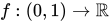
On a compact set, it is easily shown that all continuous functions are uniformly continuous. If is a bounded noncompact subset of , then there exists that is continuous but not uniformly continuous. As a simple example, consider defined by . By choosing points close to 0, we can always make for any single choice of , for a given .



Absolute continuity[edit]
Definition. Let be an interval on the real line. A function is said to be absolutely continuous on if for every positive number , there is a positive number such that whenever a finite sequence of pairwise disjoint sub-intervals of satisfies[5]

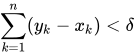
then
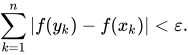
Absolutely continuous functions are continuous: consider the case n = 1 in this definition. The collection of all absolutely continuous functions on I is denoted AC(I). Absolute continuity is a fundamental concept in the Lebesgue theory of integration, allowing the formulation of a generalized version of the fundamental theorem of calculus that applies to the Lebesgue integral.
Differentiation[edit]
The notion of the derivative of a function or differentiability originates from the concept of approximating a function near a given point using the "best" linear approximation. This approximation, if it exists, is unique and is given by the line that is tangent to the function at the given point , and the slope of the line is the derivative of the function at .
A function is differentiable at if the limit

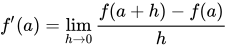
exists. This limit is known as the derivative of at , and the function , possibly defined on only a subset of , is the derivative (or derivative function) of . If the derivative exists everywhere, the function is said to be differentiable.

As a simple consequence of the definition, is continuous at if it is differentiable there. Differentiability is therefore a stronger regularity condition (condition describing the "smoothness" of a function) than continuity, and it is possible for a function to be continuous on the entire real line but not differentiable anywhere (see Weierstrass's nowhere differentiable continuous function). It is possible to discuss the existence of higher-order derivatives as well, by finding the derivative of a derivative function, and so on.
One can classify functions by their differentiability class. The class (sometimes to indicate the interval of applicability) consists of all continuous functions. The class consists of all differentiable functions whose derivative is continuous; such functions are called continuously differentiable. Thus, a function is exactly a function whose derivative exists and is of class . In general, the classes can be defined recursively by declaring to be the set of all continuous functions and declaring for any positive integer to be the set of all differentiable functions whose derivative is in . In particular, is contained in for every , and there are examples to show that this containment is strict. Class is the intersection of the sets as varies over the non-negative integers, and the members of this class are known as the smooth functions. Class consists of all analytic functions, and is strictly contained in (see bump function for a smooth function that is not analytic).

![{\displaystyle C^{0}([a,b])}](https://wikimedia.org/api/rest_v1/media/math/render/svg/f00d6ce898742eecd34c015f572eb993d854ee65)

 can be defined


Comments
Post a Comment