perfect numbers
Fermat[edit]

Pierre de Fermat (1607–1665) never published his writings; in particular, his work on number theory is contained almost entirely in letters to mathematicians and in private marginal notes.[36] In his notes and letters, he scarcely wrote any proofs - he had no models in the area.[37]
Over his lifetime, Fermat made the following contributions to the field:
- One of Fermat's first interests was perfect numbers (which appear in Euclid, Elements IX) and amicable numbers;[note 7] these topics led him to work on integer divisors, which were from the beginning among the subjects of the correspondence (1636 onwards) that put him in touch with the mathematical community of the day.[38]
- In 1638, Fermat claimed, without proof, that all whole numbers can be expressed as the sum of four squares or fewer.[39]
- Fermat's little theorem (1640):[40] if a is not divisible by a prime p, then [note 8]
- If a and b are coprime, then is not divisible by any prime congruent to −1 modulo 4;[41] and every prime congruent to 1 modulo 4 can be written in the form .[42] These two statements also date from 1640; in 1659, Fermat stated to Huygens that he had proven the latter statement by the method of infinite descent.[43]
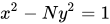
- In 1657, Fermat posed the problem of solving as a challenge to English mathematicians. The problem was solved in a few months by Wallis and Brouncker.[44] Fermat considered their solution valid, but pointed out they had provided an algorithm without a proof (as had Jayadeva and Bhaskara, though Fermat was not aware of this). He stated that a proof could be found by infinite descent.
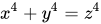
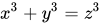
- Fermat stated and proved (by infinite descent) in the appendix to Observations on Diophantus (Obs. XLV)[45] that has no non-trivial solutions in the integers. Fermat also mentioned to his correspondents that has no non-trivial solutions, and that this could also be proven by infinite descent.[46] The first known proof is due to Euler (1753; indeed by infinite descent).[47]
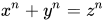
- Fermat claimed (Fermat's Last Theorem) to have shown there are no solutions to for all ; this claim appears in his annotations in the margins of his copy of Diophantus.



Euler[edit]

The interest of Leonhard Euler (1707–1783) in number theory was first spurred in 1729, when a friend of his, the amateur[note 9] Goldbach, pointed him towards some of Fermat's work on the subject.[48][49] This has been called the "rebirth" of modern number theory,[50] after Fermat's relative lack of success in getting his contemporaries' attention for the subject.[51] Euler's work on number theory includes the following:[52]
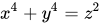
- Proofs for Fermat's statements. This includes Fermat's little theorem (generalised by Euler to non-prime moduli); the fact that if and only if ; initial work towards a proof that every integer is the sum of four squares (the first complete proof is by Joseph-Louis Lagrange (1770), soon improved by Euler himself[53]); the lack of non-zero integer solutions to (implying the case n=4 of Fermat's last theorem, the case n=3 of which Euler also proved by a related method).
- Pell's equation, first misnamed by Euler.[54] He wrote on the link between continued fractions and Pell's equation.[55]
- First steps towards analytic number theory. In his work of sums of four squares, partitions, pentagonal numbers, and the distribution of prime numbers, Euler pioneered the use of what can be seen as analysis (in particular, infinite series) in number theory. Since he lived before the development of complex analysis, most of his work is restricted to the formal manipulation of power series. He did, however, do some very notable (though not fully rigorous) early work on what would later be called the Riemann zeta function.[56]
- Quadratic forms. Following Fermat's lead, Euler did further research on the question of which primes can be expressed in the form , some of it prefiguring quadratic reciprocity.[57] [58][59]
- Diophantine equations. Euler worked on some Diophantine equations of genus 0 and 1.[60][61] In particular, he studied Diophantus's work; he tried to systematise it, but the time was not yet ripe for such an endeavour—algebraic geometry was still in its infancy.[62] He did notice there was a connection between Diophantine problems and elliptic integrals,[62] whose study he had himself initiated.




Lagrange, Legendre, and Gauss[edit]

Joseph-Louis Lagrange (1736–1813) was the first to give full proofs of some of Fermat's and Euler's work and observations—for instance, the four-square theorem and the basic theory of the misnamed "Pell's equation" (for which an algorithmic solution was found by Fermat and his contemporaries, and also by Jayadeva and Bhaskara II before them.) He also studied quadratic forms in full generality (as opposed to )—defining their equivalence relation, showing how to put them in reduced form, etc.

Adrien-Marie Legendre (1752–1833) was the first to state the law of quadratic reciprocity. He also conjectured what amounts to the prime number theorem and Dirichlet's theorem on arithmetic progressions. He gave a full treatment of the equation [64] and worked on quadratic forms along the lines later developed fully by Gauss.[65] In his old age, he was the first to prove Fermat's Last Theorem for (completing work by Peter Gustav Lejeune Dirichlet, and crediting both him and Sophie Germain).[66]



In his Disquisitiones Arithmeticae (1798), Carl Friedrich Gauss (1777–1855) proved the law of quadratic reciprocity and developed the theory of quadratic forms (in particular, defining their composition). He also introduced some basic notation (congruences) and devoted a section to computational matters, including primality tests.[67] The last section of the Disquisitiones established a link between roots of unity and number theory:
In this way, Gauss arguably made a first foray towards both Évariste Galois's work and algebraic number theory.
Maturity and division into subfields[edit]


Starting early in the nineteenth century, the following developments gradually took place:
- The rise to self-consciousness of number theory (or higher arithmetic) as a field of study.[69]
- The development of much of modern mathematics necessary for basic modern number theory: complex analysis, group theory, Galois theory—accompanied by greater rigor in analysis and abstraction in algebra.
- The rough subdivision of number theory into its modern subfields—in particular, analytic and algebraic number theory.
Algebraic number theory may be said to start with the study of reciprocity and cyclotomy, but truly came into its own with the development of abstract algebra and early ideal theory and valuation theory; see below. A conventional starting point for analytic number theory is Dirichlet's theorem on arithmetic progressions (1837),[70] [71] whose proof introduced L-functions and involved some asymptotic analysis and a limiting process on a real variable.[72] The first use of analytic ideas in number theory actually goes back to Euler (1730s),[73] [74] who used formal power series and non-rigorous (or implicit) limiting arguments. The use of complex analysis in number theory comes later: the work of Bernhard Riemann (1859) on the zeta function is the canonical starting point;[75] Jacobi's four-square theorem (1839), which predates it, belongs to an initially different strand that has by now taken a leading role in analytic number theory (modular forms).[76]
The history of each subfield is briefly addressed in its own section below; see the main article of each subfield for fuller treatments. Many of the most interesting questions in each area remain open and are being actively worked on.


Comments
Post a Comment